Transformer-based Prediction of Vehicle Aerodynamics

Oct 16, 2025·
Higgins et al
Nicolas Fougere
Nicolas Fougere
· 0 min read
Image credit: Higgins et al. 2025
Abstract
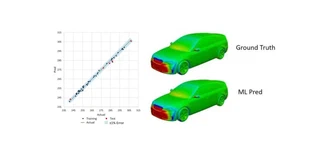
The vehicle market is evolving rapidly. New players are entering the market, many variants of a vehicle are investigated prior to freezing the design, and more. In this context, vehicle aerodynamics is ever more crucial. It directly impacts the vehicle range and plays a major role in meeting regulation targets. Vehicle manufacturers must also keep in mind the need for a shorter time-to-market, where one must design faster and not permit late-stage redesign. Therefore, faster and earlier assessment of vehicle aerodynamics is imperative. Computational Fluid Dynamics (CFD) has opened the door to virtual aerodynamic testing, allowing manufacturers to test their vehicle shapes before developing a costly and time-intensive prototype that then needs to be experimented on using a wind tunnel. While high-fidelity CFD, such as the PowerFLOW® software from Dassault Systèmes, will remain an integral part of the aerodynamic development process of major OEMs, the growth of machine learning (ML) and continual improvement of its algorithms has opened doors to speed-up computational aerodynamics, allowing automotive manufacturers to get feedback on their vehicle design in a matter of minutes. The current work illustrates how aerodynamic data obtained using the Lattice Boltzmann Method with PowerFLOW® combined with transformer-based ML can enable car manufacturers to obtain clean 3D contour plots of the vehicle’s surface X-force (or any other simulated quantity) distribution and the associated integrated vehicle drag force within several minutes on a single GPU (after training of the ML model). This represents a significant reduction in computational cost and time.
Type
Publication
FKFS Conference On Vehicle Aerodynamics and Thermal Management
Status
Peer-reviewed Open access
publications
Nicolas Fougere
Authors
Senior Portfolio Manager

Nicolas Fougere is a technology leader with experience helping global industrial organizations accelerate innovation through digital engineering and transformation. As a Senior Portfolio Manager at Dassault Systèmes, he works with manufacturers and technology leaders to develop strategies around virtual twins, simulation, systems engineering, and AI.

Before joining the private sector, Nicolas contributed to scientific research supporting NASA and the European Space Agency’s Rosetta mission and authored numerous peer-reviewed publications. He holds advanced engineering and scientific degrees from the University of Michigan.

Nicolas is passionate about connecting technology, business strategy, and customer success to help organizations solve complex challenges, build high-performing teams, and create lasting business value.